By Patricia J. Angus
Historical Photos courtesy of the Mifflin Township Historical Society

I called my dad and asked him, “Hey, what do you know about Nick L..…?” “Nick Lee Hollow? We played there all the time!” he blurted out before I could complete my sentence. It was obvious that these words brought back a flood of memories, because Dad spoke with great enthusiasm, and I couldn’t write fast enough to keep up with him. Dad’s family lived at 220 North First Street in Duquesne during the mid-forties, the War years. He would have been in his pre to early teens at that time.
“When we wanted to wrestle in the soft grass,” Dad said, “we would play in the circle
at the top of First, Second, and Third Streets. But, if we wanted to play football or baseball, we played in the hollow which was made of slag.” He threw out a few family names – Castro, Cantino, and Jelicic – guys he used to play football with. Technically Nick Lee Hollow includes the entire area extending from Polish Hill — to the train tracks under the Thompson Run Bridge — all the way to the river. To get to the hollow, Dad said they climbed down stairs that existed somewhere around the north end of Fifth Street and played in the large vacant space all the way down to the bridge at Duquesne Boulevard. He recollected that Ziegler Lumber Company was on the far side of the bridge by the river.

In 1999 Jim Hartman, president of the Mifflin Township Historical Society, reproduced a booklet originally published for the Duquesne Silver Jubilee in 1916. According to this publication, the hollow was previously part of farmland that changed hands several times, and by 1841 became the property of Dr. George Oliver. Consequently, the area became known as Oliver Hollow for many decades. I am not sure how the name Nick Lee Hollow came into being, but Hartman identified Nick Lee as an African American who lived in the hollow and who was employed as the “night soiler” (garbage man), for the city of Duquesne.
Lee wasn’t the only former resident of the hollow. Prior to the summer of 1928, Oliver Hollow was home to many families. According to a Commentary written in 1993, housing in the hollow was constructed by the steel company to accommodate mill workers. Some of the resident families were identified on this photo contributed to the Mifflin Township Historical Society by Dom Toretti of Dom’s T.V. Also in the background of the photo you can see the Thompson Run Bridge extending over the train tracks and the Duquesne Merchant Mills in the distance. My dad commented during our conversation that he thought the houses down in the hollow were just a continuation of the streets in Duquesne. Tidbits of information were coming my way, and I became curious, so I made some comparisons.

Photo donated to the Mifflin Township Historical Society by Dom Toretti .

I compared the photo containing family names with the 1920 United States Federal Census and a 1925 map of Duquesne, and I did find a correlation. Those dirt roads in the photos did have street names, and the families who lived there were indeed enumerated on the census records. Although some of the housing appears to have been erected by the steel mill, many of the residents did own their own property. I have superimposed the street names onto the picture, but you won’t find these addresses on Google maps, because the entire neighborhood was abandoned after total destruction struck on the Fourth of July, 1928.*

Photo donated to the Mifflin Township Historical Society by Dom Toretti .
Holiday memories made by families who lived in Oliver Hollow were swept away by a horrific flood that fateful evening. According to the July 6, 1928 issue of the Duquesne Times (page 7), 125 families from the area of Oliver Hollow were rescued from desolation and accommodated by other residents of the city. The cause of the flood was more than torrential rains mingled with the water of Thompson Run. Usually water drained from the hollow via a 4-foot culvert, but the pipe became clogged with debris from the storm, so the water could not escape.
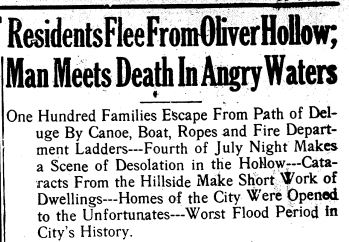
Newspaper courtesy of the Mifflin Township Historical Society.
One death resulted as Peter Petrocsko, Sr., age 45, died attempting to assist in the rescue effort of his son, Peter Petrocsko, Jr., and the neighboring families of Mike Brinsko, John Scaronki, Mike Petrosik, George Cipkala, and Mike Septicula. According to the Times, Patrocsko, Sr.’s “body was found near the door (of his son’s residence) which he had apparently opened to get out and was knocked down by the onrushing waters.” I have marked this address with a star in the above photograph with the yellow labels.

Photo donated to the Mifflin Township Historical Society by Dom Toretti .
Subsequently Oliver Hollow was abandoned after the July 4th damage. The clearing provided the steel company with more capacity to dispose of wastes, eventually filling the void with additional slag. Although not officially part of the city’s playground program, this dumping ground gradually transformed into Nick Lee Hollow, a recreational area for my father and other young people of Duquesne. Through the passage of time, lively voices of children in the hollow have drifted away, and new generations are unfamiliar with the past. Before the deluge of the decades destroys all evidence of their stories, let us remember this place as a memorial to Mr. Petrocsko, Nick Lee … and our dads.
(c) 2013 to present Patricia J. Angus
- See also Penn State University Libraries, Digital Collection — Maps of Duquesne, Allegheny, Pennsylvania

Photo donated to the Mifflin Township Historical Society by Dom Toretti .


Leave a Reply